 Serangoon TCM Centre:
Written by: Tan Jiaying Viviana (TCM Physician)
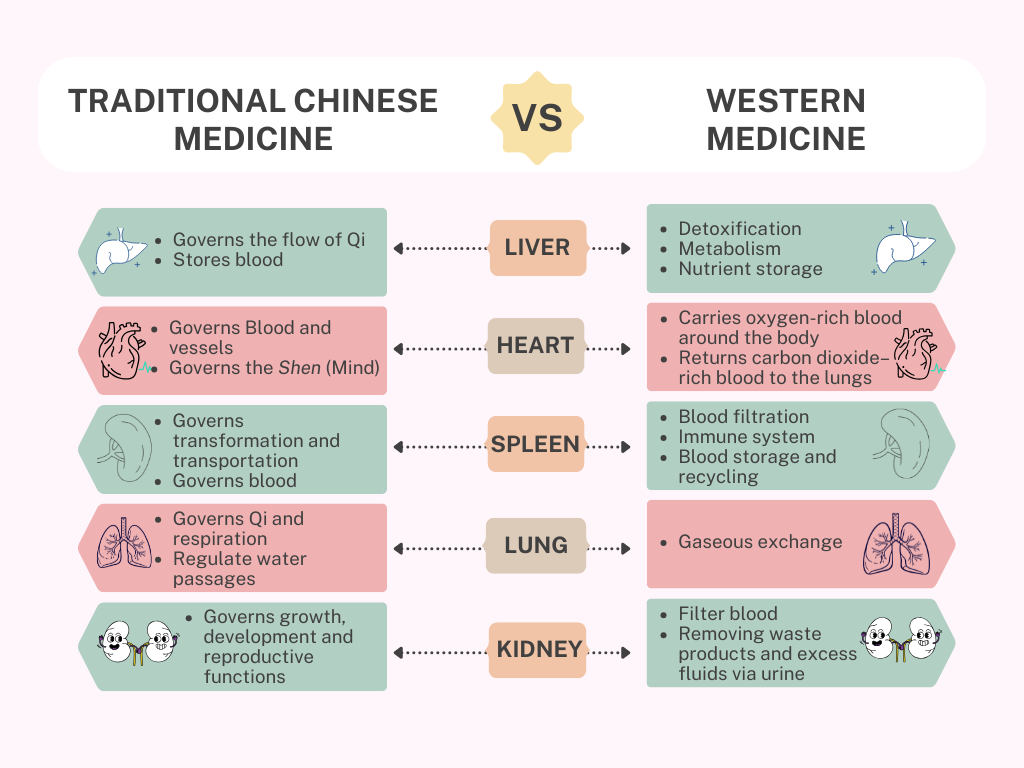
Have you ever heard a Traditional Chinese Medicine (TCM) practitioner explain that the “Liver, Heart, Spleen, Lung, and Kidney” in TCM are not exactly the same as organs described in Western medicine? If so, you may have wondered what that really means.
In TCM, the Liver, Heart, Spleen, Lung, and Kidney refer to the “Five Zang Organs”. These organs are viewed not only as physical structures, but also as interconnected functional systems that maintain balance within the body. They are linked to the Five Elements and are associated with natural factors such as seasons, climate, and flavours. For example, the Liver corresponds to Wood and the sour flavour, while the Heart corresponds to Fire and the bitter flavour.
From a Western medicine perspective, organs are primarily understood through anatomy and physiology. Each organ is studied according to its structure and biological role. For instance, the liver detoxifies substances, the heart pumps blood, the spleen contributes to immune function, the lungs perform gas exchange, and the kidneys filter waste and produce urine.
The Liver System
In TCM, the Liver is known as the “General of the Army” because it regulates and coordinates the smooth movement of Qi and Blood throughout the body. It also stores Blood and is closely associated with emotional balance.
I. The Liver Governs the Flow of Qi
The Liver helps maintain the smooth circulation of Qi, blood, and body fluids. When Liver Qi flows harmoniously, emotional and physical functions remain balanced. However, stagnation of Liver Qi may disrupt circulation and fluid metabolism, potentially contributing to symptoms such as menstrual pain, irregular menstruation, edema, irritability, anxiety, or depression.
II. The Liver Stores Blood
The Heart is regarded as the “Monarch Official”. It governs blood circulation and is closely associated with mental and emotional activities.
I. The Heart Governs Blood and Vessels
In TCM, the Heart houses the “Shen”, which refers to mental, emotional, and consciousness-related activities. It depends on adequate nourishment from the Heart Blood. When Heart Blood is insufficient, symptoms such as insomnia, anxiety, restlessness, or poor concentration may arise.
The Spleen System
I. The Spleen Governs Transformation and Transportation
II. The Spleen Governs Blood
The Lung System
In TCM, the Lungs are associated not only with respiration, but also with the regulation of body fluids.
The Kidneys are regarded as the “foundation of innate constitution”. They store “Jing” (Essence), which is inherited at birth and continuously nourished by nutrients derived from food.
Kidney Essence supports growth, development, reproductive maturity and fertility. As people age, Kidney Essence gradually declines, and bodily functions correspondingly weakens. Hence in TCM, delayed growth, infertility, or declining reproductive function are often associated with Kidney dysfunction.
In conclusion, Western medicine focuses on anatomical structures and biological functions, while TCM emphasises balance, functional relationships, and the body’s interaction with its environment. Understanding these different perspectives can help us appreciate how each approach contributes to health and well-being.


